The Kitsune of the Oji Inari shrine
- mappingfolktales
- Dec 30, 2025
- 3 min read
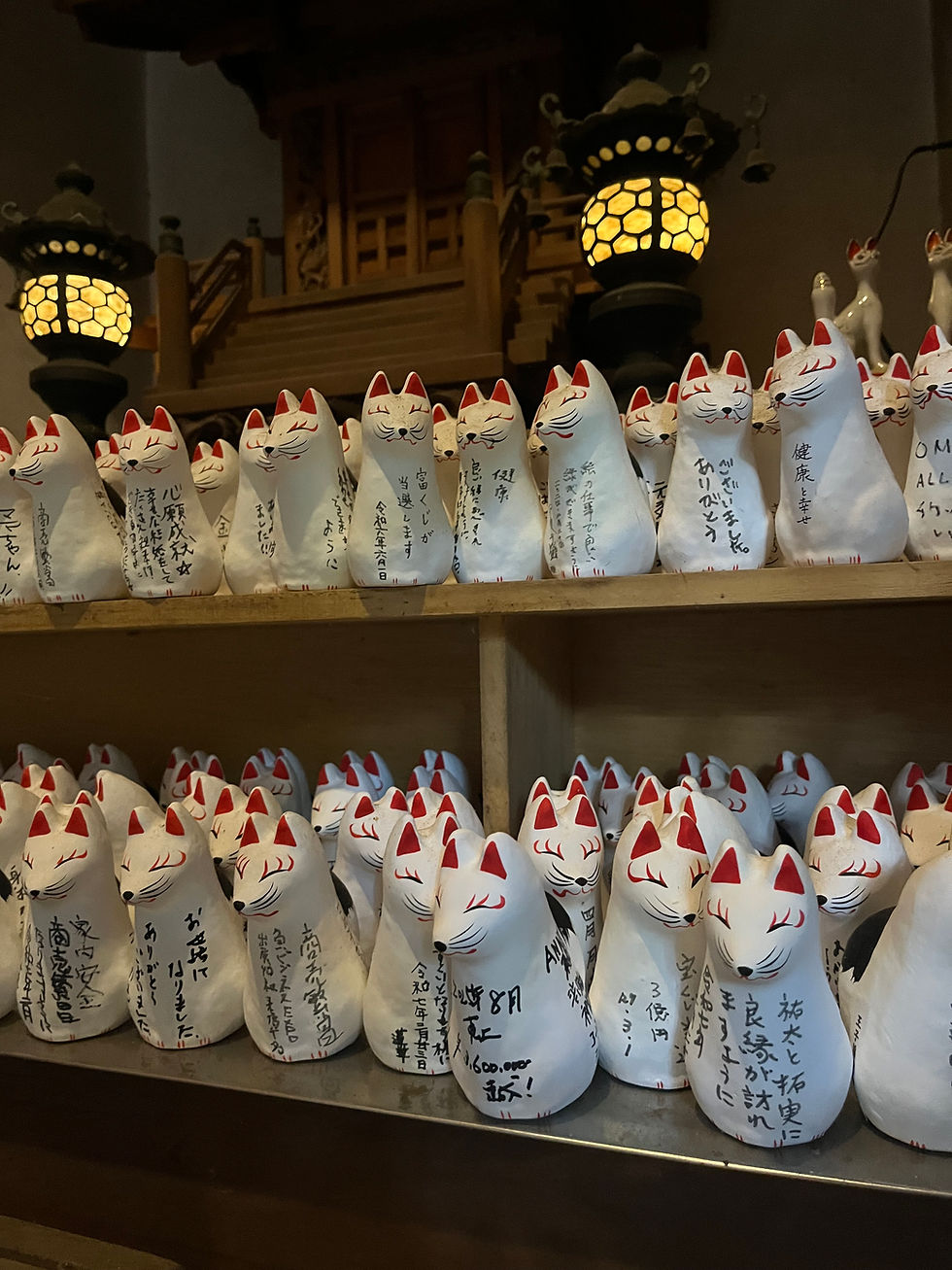
New Year is considered one of the most important times of the year in Japanese culture. During this holiday period, which usually lasts a few days, Japanese people travel to visit their families and spend time together, relaxing and enjoying special traditional food. Before the New Year, families deep-clean their house to wipe away the previous year’s misfortune and worries and be ready to welcome the New Year. In fact, New Year is meant to foster a positive new beginning, leaving behind the previous year worries and negative feelings to welcome luck.
Other common rituals include exchanging gift money and praying at the temple or the shrine at the beginning of the New Year. At the temples and shrines, people pick their own Omikuji, a small paper that will tell the person’s fortune for the upcoming year. Traditionally, if good fortune is drawn the small paper will be preserved by the person. If the luck is not good, the paper will be hung and tied together with many others to leave the bad luck behind. Besides these popular rituals, from place to place there can be special traditions that are of specific temples or towns.
Today, I would like to introduce a unique shrine, the Oji Inari shrine. This shrine is well known for tales related to kitsune folklore, mythological, shape-shifting foxes famous for their wit and trickster characteristics. It is in particular during the New Year period that in this shrine the links with the kitsune are remembered and honored through a fascinating ritual still observed today.
The Oji Inari temple is located in the town of Oji, North of Tokyo. According to local folklore, this temple is the head temple for all the Kitsune in the Kanto region.
Until the 20th century the area was dedicated almost exclusively to rice farming. In an area where fertility was crucial for the harvest, folktales narrate that at the time the Kitsune used to gather during New Year’s Eve under a heckberry tree. Farmers report that their Kitsunebi could be seen from miles away. The kitsunebi is literally translated as the fire of the kitsune, which in Japanese folklore appears as a sort of lantern to human eyes. However, the fire is said to be caused by the movement of the kitsune’s tail or their breath. From the tree, the kitsune would parade to the shrine dedicated to Inari. Since traditionally these supernatural creatures are messengers of Inari, the god of fertility and fortune, the tales say that the length of the kitsunebi would tell the people what the year’s fortune would be.
It is not surprising that such an important shrine for this mythological creature, has also a crucial role during New Year, a cardinal time in Japanese culture. In fact, according to tales and myths, by tradition the kitsune of Eastern Japan still gather there on New Year’s Eve to express gratitude and make wishes for the year ahead.
Nowadays, if you happen to visit the Oji Inari shrine on New Year’s you would be able to attend and witness a unique parade: the Oji Fox Parade. Since 1993 the people living in the town recreate the folktale of the kitsune’s gathering by dressing up as kitsune themselves and walk to the shrine to pray for fertility and prosperity in the coming year. During the parade, participants wear kitsune’s masks and carry lanterns to symbolise foxfire.
This year too the parade will take place, and begin shortly before midnight on the 31st of December to conclude in the first hours of January 1st.
Despite this folktale lacking an exhaustive written record, the myth has been passed down from elders to younger generations in the town of Oji. Related to the tale, there is a famous woodblock print created by Utagawa Hiroshige in 1857 called “New Year’s Eve Foxfires at the Changing Tree, Ōji”. The painting is preserved at the Metropolitan Museum of Art of New York, part of the collection One Hundred Famous Views of Edo of the author. The description of the woodblock recites:
“Foxes gather at the large, old enoki (hackberry) tree on New Year’s Eve to prepare to pay homage at the Ōji Inari shrine, the headquarters of the Inari cult in eastern Japan (Kantō). The cult centers on the god of the rice field, for whom the fox serves as messenger. On the way to Ōji, the foxes have set a number of kitsunebi (foxfires), which farmers count to predict the upcoming rice harvest.”


Comments