Sacred ancient trees and kodama tales.
Updated: Jun 25
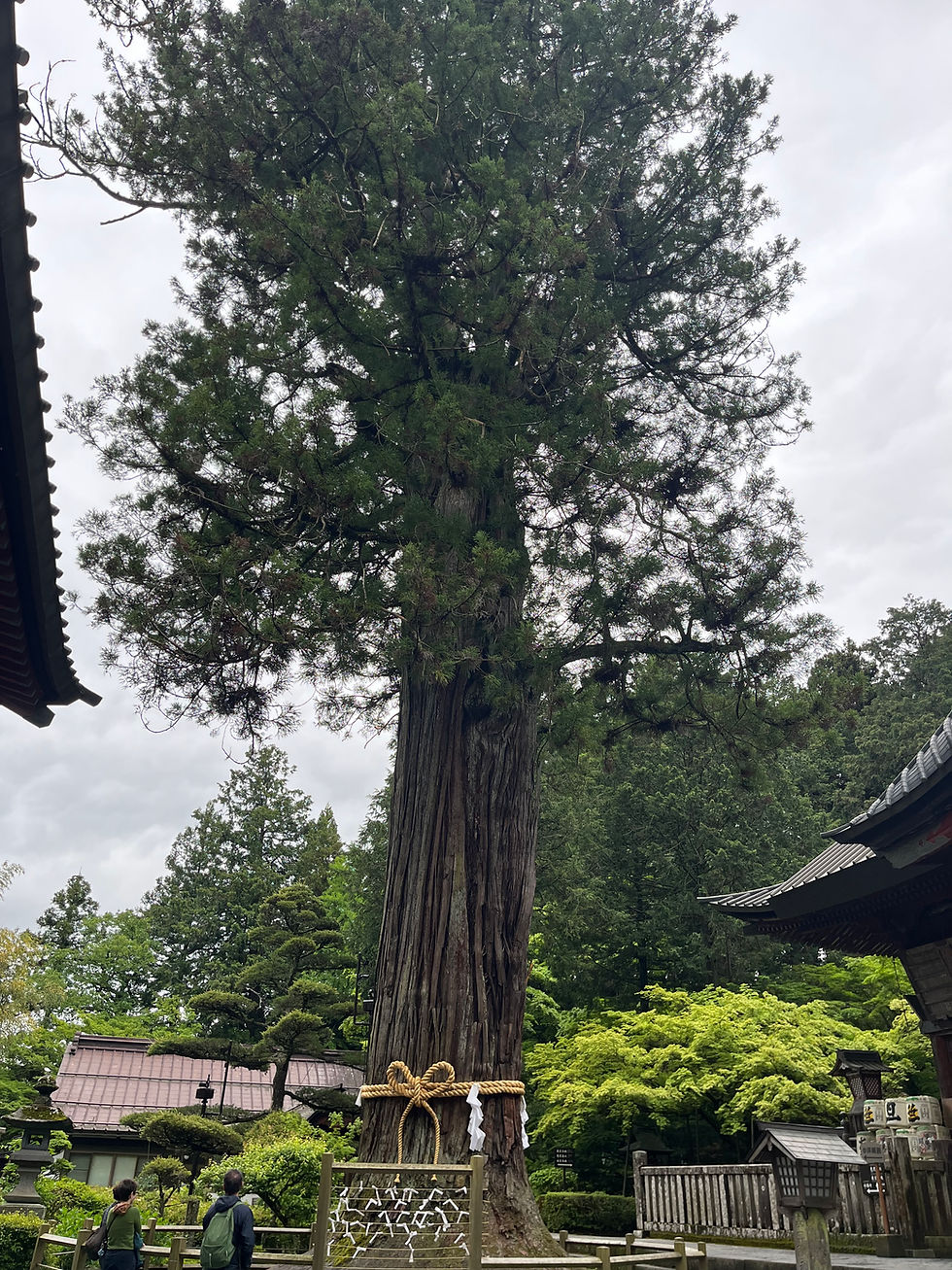
On the North side of Mt Fuji, Japan’s most famous mountain and UNESCO World heritage site, is located the Fujiyoshida Shrine. Dedicated to Konohana-sakuya Hime (her legend has been narrated in the “Konohana-sakuya Hime, the Blossom Princess” article) the shrine used to be a starting point for those aiming to climb the mountain: in fact, its strategic location would shorten the climb to the summit.
The shinto shrine is hidden inside an ancient forest: cedar and cypress stand tall, hiding the torii that welcome the visitors. It is impossible to not remain in awe to admire the tall trees that form the beautiful forest of the shrine. In the main hall, two colossal trees of more than 1,000 years old, are wrapped in shimenawa ropes. The shimenawa rope can appear rather curious for those that are not familiar with its meaning: it is a thick rope made of laid rice straw or hemp, wrapped around the tree with a couple of turns. Adorning it, are white paper streamers called shide. In Shinto religion, such rope is used for ritual purification and for sacred landmarks. The rope wrapped around the trees symbolize their sacred nature. Such sacredness is not due to any inherent sanctity of the trees themselves; rather, they are believed to be inhabited by spirits and kami (deities).
One of the possible inhabitants, and the main focus on this article are kodama, the tree spirits. In pop culture, kodama have been highly popularized by Hayao Miyazaki in his famous movie “Princess Mononoke”. However, the kodama of the movie are represented in an original way, as spectral humanoid figures, typical of more recent interpretations of the spirits. In traditional descriptions, kodama are not conceptualized as tangible beings, but as spirits, an energy inhabiting trees. The trees inhabited by kodama are ancient. They need to surpass at least 100 years in age for a spirit to take residence in it. Oftentimes, the kodama reside in these ancient trees inside forests located in mountain areas and their life is deeply connected to the life of the host. It is said that if a tree hosting a kodama is cut, a curse will be unleashed. The curse does not fall only on one person, but entire villages could fall into despair. In addition, the trunk of the tree could even bleed real blood and, when the tree falls, the sound produced is the scream of the kodama.
Trees have been revered and respected for a long time in Japan and the tree spirits are a symbol of the deep relationship the country has with nature, which could be perceived as a form of animism. In ancient times kodama used to be worshipped like gods. It was told that they could protect families and villages, their goal was to keep their tree and the surrounding area flourishing. Therefore, everyone in the surrounding area would benefit from it. First mentions of tree spirits is to be found in Japan's most ancient known book, the Kojiki (712 CE). The book dwells into rites, ceremonies, customs and magical practices in ancient Japan. However, later in time, kodama lost their gods rank and were classified as yokai (a term that includes monsters, spirits, demons and all mysterious beings in Japanese folklore). Such a change in their perception also brought to the production of tales where kodama could take human shapes, and even to the production of love stories between kodama and humans. However, due these historical changes, there is no general agreement on how a kodama should look like.
It is easy to understand now why the vision of these sacred old trees at the Fujiyoshida Shrine brought me wonders of tree spirits, and specifically about kodama. Being located in a mountain area I wondered if a kodama could be inhabiting one of these trees.
To conclude this article, I will report here a shortened version of a famous folktale involving a kodama. In the tale, a samurai and a kodama fall in love but their story has a sad tragic ending.
Tomodata, a young samurai that owed allegiance to the Lord of Noto, was sent on a mission by the Lord. Before departing, he promised his Lord to not fall in love with any woman while travelling.
During his mission, Tomodata lost the road. It was a wide lonely place that seemed inhabited by any soul. “Alack!” he cried, “must I die in this wilderness and the quest of the Lord of Noto be unfulfilled?”
After he pronounced these words the wind blew away the clouds and allowed him to see a cottage on the top of a hill. In front of it, grew a green weeping-willow tree.
An elderly couple welcomed the samurai in the cottage and the daughter took care of the horse of Tomodata. Tomodata remained fascinated by the young girl and regarded her as the fairest girl he has ever met.
“Maiden,” he said, “what is your name?”
She answered: “They call me the Green Willow.”
“The dearest name on earth,” he said, and again he looked her between the eyes. At last Tomotada lay down to sleep. Outside, the wind moving through the leaves of the willow trees made a gentle music. Words for that music rose in his mind: “Green Willow. My wife will be Green Willow.”
The next morning was time to leave for Tomodata, even if with great sadness, he had to continue his quest. With a heavy heart Tomotada watched as Green Willow led his horse from the stable. He saw the tears in her eyes. He knew then that he could never leave her. “I will be back,” he said, “as soon as my duty is fulfilled.” He mounted his horse and rode away. The night after, he decided to stay at a temple to rest. Surprisingly, he heard a movement in the darkness. Instinctively drawing his sword, he called out, ”Who is there? Show yourself or I will strike.” A figure rose from the shadows. “Green Willow!”He sheathed his sword and held her close. He decided to never separate from her again.
They rode together and at night, they reached a city where they stayed. They married and, with the money and jewels Tomotada carried sewn into the lining of his robe, they built a house near a stream. “Someday.” He said, “I shall return to my lord and ask for his forgiveness. But not yet. No, I can not leave yet.” They ended up staying in that place for three years and their love flourished. In the autumn of their third year, while observing the moon rise from their garden, Green Willow began to shake and shiver.
“My dear,” said Tomodata, “you shake and shiver; and it is no wonder, the night wind is chill. Come in.” And he put his arm around her.
At this she gave a long and pitiful cry, very loud and full of agony, and when she had uttered the cry she failed “Tomodata,” she whispered, “say a prayer for me; I die.”
“Oh, say not so, my sweet, my sweet! You are but weary; you are faint.”
He carried her to the stream’s side, and washed her forehead with water. He said: “What is it, my dear?”
“The tree,” she moaned, “the tree … they have cut down my tree. Remember the Green Willow.”
With that she slipped, as it seemed, from his arms to his feet; and he, casting himself upon the ground, found only silken garments, bright coloured, warm and sweet, and straw sandals, scarlet-thonged.
The tale concludes with the samurai casting away his sword, in grief, and becoming a holy man. After some years, he visited the old cottage and saw the tree that had been cut down. The old samurai decided to stay near the dead willow and to build a hut to live in. The tale narrates that in spring he discovered a green sprout growing from the dead tree and he tended to it. When Tomodata life came to an end, a seed from the young willow tree fell, and a new tree grew from the place where his bones rested. According to the tale, the two willow trees grew and their roots, trunks and branches intertwined with each other in an eternal hug.


Comments